The Folding Table Doesn't Lie: Seven Lessons From the Merch Line
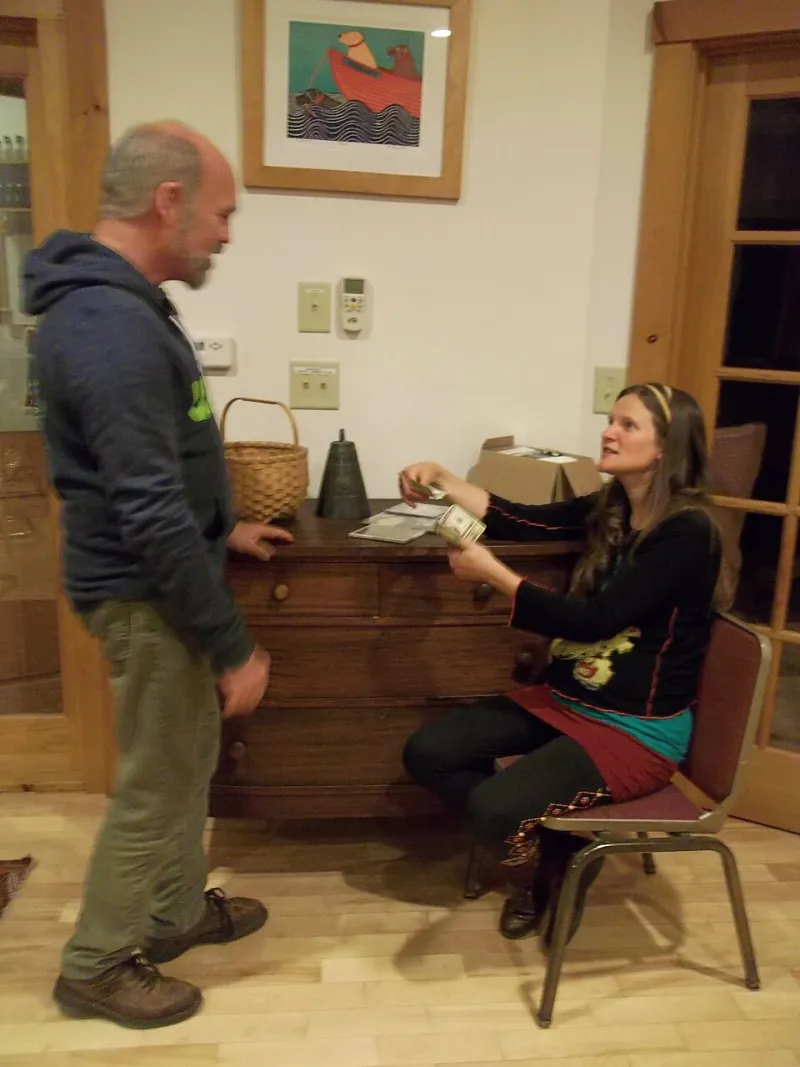
Photo: Artaxerxes, CC BY-SA 4.0, via Wikimedia Commons
It's 11:42 p.m. The house lights are at half. The line is fourteen people deep, one of them is holding a beer they will definitely set down on my table, and the card reader has decided tonight is the night it stops believing in wireless internet.
This is the merch table, and it is the most unscripted performance I give all night. No sound check, no setlist, no lighting cue to tell me when to be charming. Just a folding table, a stack of shirts in three sizes (two of which are already gone), and a line of people who have decided, for reasons of their own, that they'd like a word.
I've worked a lot of these tables. Here's what they've taught me.
1. The Line Is a Conversation With a Timer
People in a merch line are not a queue. They're a series of one-on-one conversations happening in public, each with a hard social limit of about ninety seconds before the person behind them starts shifting weight from foot to foot.
Once I understood that, the whole job got easier. You get one real exchange per person — a question, a compliment, a joke — and then you close it warmly and move on. Not because you don't care, but because the person behind them also paid for a moment of your attention.
2. Price It Like You Mean It
I spent my first two years apologizing for my prices. "It's twenty-five, sorry, I know that's — it's a good shirt, I promise." Nobody wants to buy a shirt from someone who seems embarrassed by the shirt.
Set a price that respects the work, say it plainly, and then stop talking. If someone hesitates, that's information, not an insult. You can always offer a sticker or a poster instead. What you can't do is talk someone into feeling good about a purchase they already felt weird about.
3. Nobody Wants the Origin Story at Midnight
There's a version of me who, when asked "so what's your stuff like?", delivers a four-minute explanation of my influences, my process, and my third album. That version of me is standing there at 11:50 p.m. watching a stranger's eyes glaze over.
The good version says: "It's loud and it's funny and there's a slow one in the middle." That's it. That's the pitch. Save the rest for the podcast interview you're going to do eventually.
4. The Shirt Buyer Isn't Always the Superfan
This one genuinely surprised me. The person who buys the shirt is often not the person who screamed the loudest during the set. Sometimes it's the quiet one in the back who came alone and just wants to say thank you without a lot of eye contact. Sometimes it's a parent buying something for a kid who's too shy to come up.
Which means the merch line is not a leaderboard of devotion. It's just a room full of people with different ways of showing up. Reading it as a scoreboard will make you weird and a little bitter. Reading it as a cross-section of the audience will make you better at your job.
5. "No" Is a Complete Sentence — Practice It
You will be asked for things at the merch table that you do not want to give: a free shirt, your personal number, a photo at an hour when your face has stopped working, a listen to someone's demo, a promise to come to their show.
You are allowed to say no. You are allowed to say "not tonight, but thanks for asking," and you are allowed to say it without a paragraph of justification attached. Nobody has ever remembered the performer who over-explained a boundary. Plenty of people remember the one who was gracious and clear.
6. The Card Reader Will Humble You
Every night, without fail, something about the transaction breaks. A tap doesn't register. A QR code refuses to load in a basement with no signal. Someone's card is declined and everyone nearby pretends not to hear it.
This is where you learn whether you can be calm in front of a small audience. Because a merch line is an audience — eight people watching you troubleshoot a device with a smile on your face. If you can survive that without visibly spiraling, you can survive most things.
7. Close the Table the Way You Close a Set
For a long time I just packed up whenever the line thinned out, which meant the last few people got a version of me that was already halfway to the van. That's a bad way to end an evening.
The fix was simple: when the clock hits a certain point, I say it out loud. "Hey, I'm going to close up in about five minutes — if you're thinking about something, now's the time." Then I pack in order, thank the venue staff by name, and leave the table looking like somebody cared about it.
The table is the last thing the room sees of you. It's worth treating like part of the show, because to the person standing in front of it, it is.